

Hello friends!
Today we start reading Orlando by Virginia Woolf! We will start by reading chapters 1 and 2. In this post:
WHAT YOU WILL NEED TO PARTICIPATE
A CONVERSATION WITH NANCY MILLER containing some introductory remarks about the novel (this should appear at the top ↑)
A BRIEF SUMMARY of the opening pages of Orlando
A FEW OBSERVATIONS about the opening pages of Orlando.
1. What you will need to participate
What you will need:
A COPY OF ORLANDO
THE READING SCHEDULE (feel free to follow or ignore – its main purpose is to mark when my posts will be coming out and in what cadence, but you can come to them any time)
A CAN-DO ATTITUDE and willingness to keep reading! There are some strange and florid sections in this book – just keep going!
A PENCIL to underline bits that catch your attention or that you’re unsure about and want to bring to the group (which you can do in the comments). Please do not annotate your book in pen, you uncouth so-and-so.
VITTLES AND HYDRATION
What you don’t need:
A degree in English literature
Any special knowledge of Virginia Woolf (though an interest in knowing more about her and her writing might be useful)
All the answers
A pen.
What I will supply:
POSTS offering a summary and observations after every two chapters (there are six chapters all together, so after this post, there will be three more).
PODCASTS about the novel, recorded with the exceptional NANCY MILLER – tone: informal and exploratory.
A PLACE FOR YOU TO SHARE THOUGHTS, OBSERVATIONS, QUESTIONS about the novel. The comment section beckons – go on! I love reading your comments!
THE OLD RAZZLE DAZZLE (Just joking.)
2. My conversation with Nancy
In my conversation with Nancy Miller (at the top of the post ↑), we offer some opening remarks about the novel, without getting too deep into the major themes. My voice in the recording is a bit echoey I’m sorry. It seems that my microphone wasn’t working so my laptop mic valiantly stepped into the breech. But Nancy sounds great – she always does! – so that’s good. I’ll sort out the mic for next time.
Those of you who read To the Lighthouse with me last year will already know Nancy. For those of you who don’t know, Nancy is an experienced teacher of literature – having most recently taught at a community college in Olympia, Washington. She has a longstanding interest in Virginia Woolf (having written her graduate thesis on Woolf) and I am, as always, grateful for her participation!
3. A brief summary of the opening pages of Orlando
We first meet Orlando as a sixteen-year-old boy play-fighting in an attic room of his gigantic home. He has strung up the head of a Moor to a rafter and is slicing it with a sword. We find out that Orlando’s ancestors were great men – they came out of the mists of time with crowns on their heads and have, since then, fought in glorious battles abroad, something Orlando plans to do also when he is older. A stained glass window containing the family coat of arms casts its colours over Orlando. The ‘biographer’ who narrates the novel gives a physical description of Orlando – he is youthful and noble and handsome. Soon Orlando leaves off playing with his sword to sit down at a table and write some poetry. In no time he has covered ten pages with writing.
4. A few observations about the opening pages of Orlando
(I had rather a lot of fun researching all the bits and pieces in this section!)
Dedication
Woolf dedicated the novel to Vita Sackville-West, also a writer, with whom she had an affair during the twenties. Both women were married. In Vita’s case, the marriage was open with both Vita and her husband engaging in homosexual affairs. Vita was a member of the ancient Sackville family which traced its ancestry back to William the Conqueror. The Sackvilles were made Earls of Dorset in the sixteenth century and were granted Knole, their grand house in Kent, by Elizabeth I – a house reputedly with seven courts, 52 staircases and 365 rooms.1
Biographer Hermoine Lee writes that Vita, well known in her circle as a lesbian, ‘cross-dressed, she had lesbian and homosexual friends, she had figured in a lesbian scandal, and she had a reputation for passionate and predatory affairs’ but, as with other queer writers of the time, ‘she kept her explicit lesbian writing in the closet’.2
Though Woolf was herself attracted to women, she did not define herself as ‘lesbian’ or ‘Sapphist’ as she termed it. ‘These Sapphists love women; friendship is never untinged with amorosity’, Woolf wrote in her diary in 1925.3 In the same entry, she described Vita:
I like her & being with her, & the splendour—she shines in the grocers shop in Sevenoaks with a candle lit radiance, stalking on legs like beech trees, pink glowing, grape clustered, pearl hung. That is the secret of her glamour, I suppose. Anyhow, she found me incredibly dowdy, no woman cared less for personal appearance […] In brain & insight she is not as highly organised as I am. But then she is aware of this, & so lavishes on me the maternal protection which for some reason, is what I have always most wished from everyone.
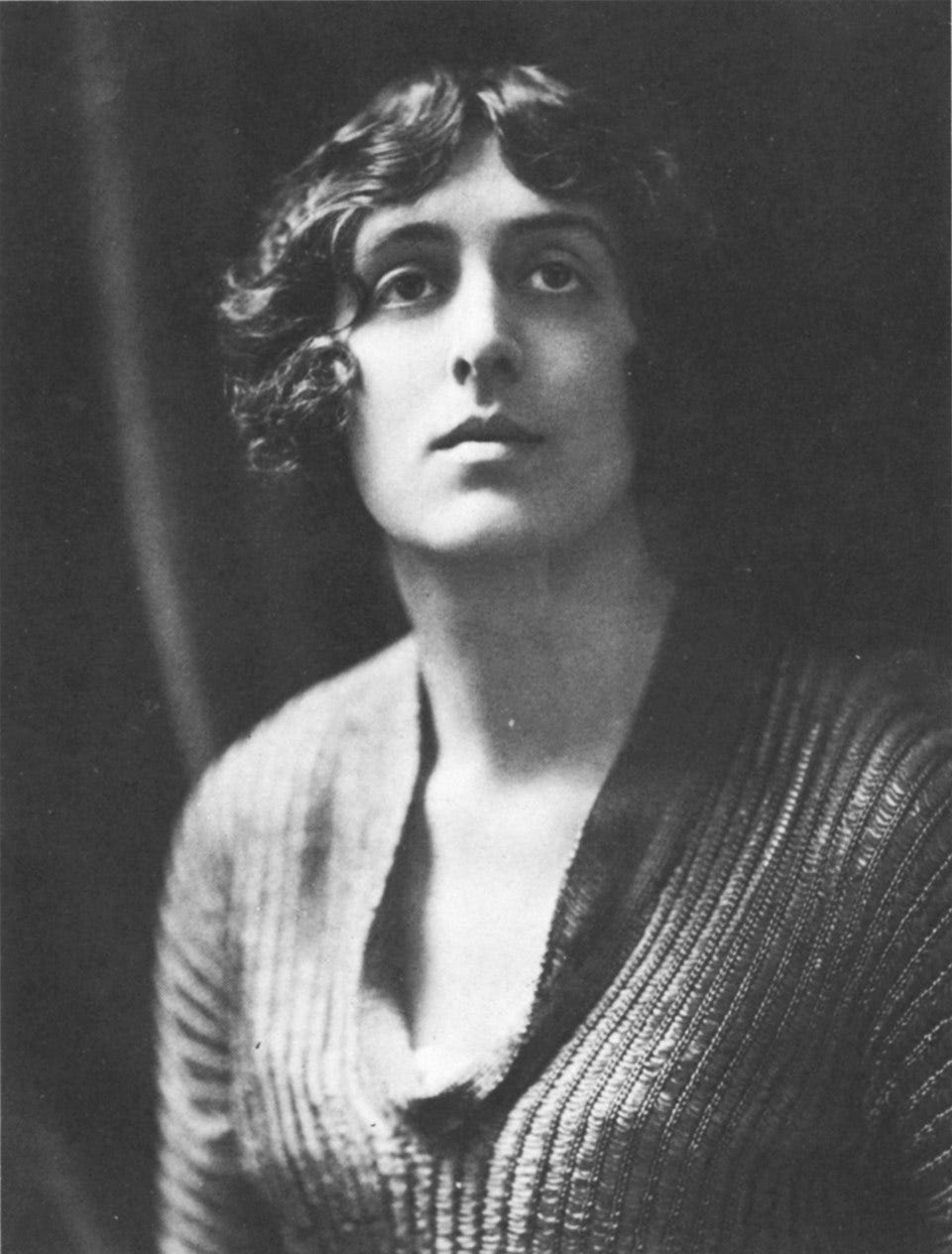
Orlando is, at its heart, a mock biography of Vita, with Orlando modelled on her and her ancestors. To write the book, Woolf researched Vita’s family and visited Vita’s grand family home, Knole, which forms the model for Orlando’s home in the book. Woolf’s research drew heavily on Vita’s own history of the family, Knole and the Sackvilles, published in 1922.
Further information about Vita, along with Woolf’s approach to writing the novel is offered in the Reading Schedule.
The cover of the first edition
Before we move on, let’s consider the rather fascinating cover of the first edition of Orlando.
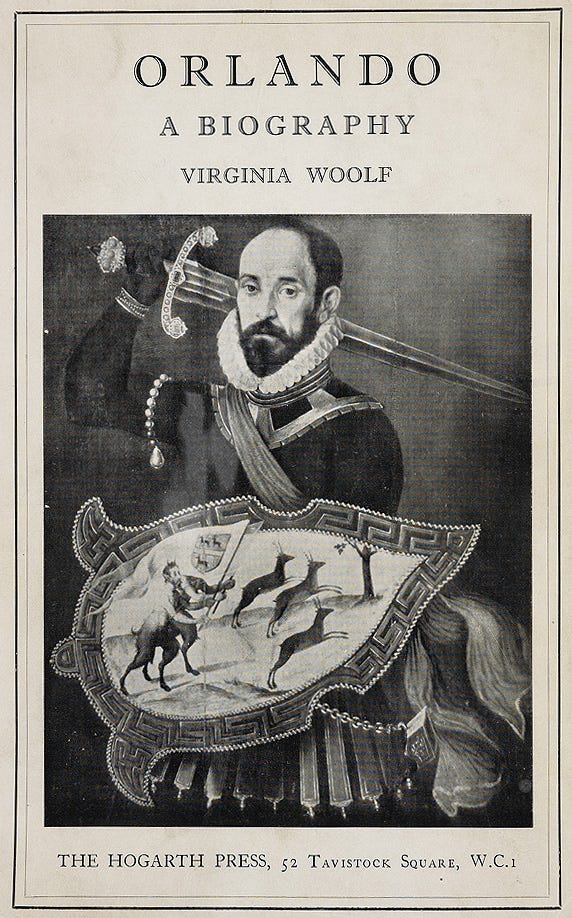
The artwork is a reproduction of a painting of Thomas Sackville, one of Vita’s ancestors, who was an advisor to Queen Elizabeth I. Academic Julie Vandivere points out that although there were many paintings of Thomas available to choose from, Woolf opted for the one unlike any of the others – the one in which Sackville is given the head of an Anglo-English nobleman and the body of a Black man.4 Vandivere quotes L F Salzman who, in 1941, gave the following description of the painting:5
It shows a three-quarter length figure of a negro, or Moor—for his skin is dark brown and not black. He is naked except for a metal gorget or neckpiece and a waistline… The right arm, adorned with a bracelet and, higher up, a bangle of pearls, holds a jeweled hilt of a sword, which passes behind the figure. This head, almost full face, emerges from a ruff and is that of a Northern European, a man of about 40 with dark hair and close-trimmed beard. The shield…shows a landscape in which two satyrs side by side, one almost hidden by the other, each carrying a banner, are driving before them three deer towards a tree.
The choice of this painting for the book cover gestures to racial ambiguity, which will be taken up in various ways in the novel, and perhaps an interesting intersection of race, empire and class. While racial ambiguity is not given quite as much prominence as sexual ambiguity, there will be moments later in the book where, as Vandivere points out, Orlando considers his own racial composition and points out ‘a certain darkness in his complexion’ and ‘wondered if, in the season of the Crusades, one of his ancestors had taken up with a Circassian peasant woman’. Other racial allusions occur later in the book which we will discuss as they come up.
Question: What do you make of the original cover? What do you think Woolf’s intention was in choosing this particular painting of Thomas Sackville?
Frontispiece, Orlando as a boy
The novel opens with an image of Orlando as a boy. The painting co-opted for this purpose is a portrait of Edward Sackville, son of Edward, fourth Earl of Dorset. (You will notice that the images chosen to illustrate Orlando at various ages are all pictures either of Vita or of Vita’s Sackville ancestors.)
The painting by Cornelius Nuie completed in about 1640 is actually a double portrait.
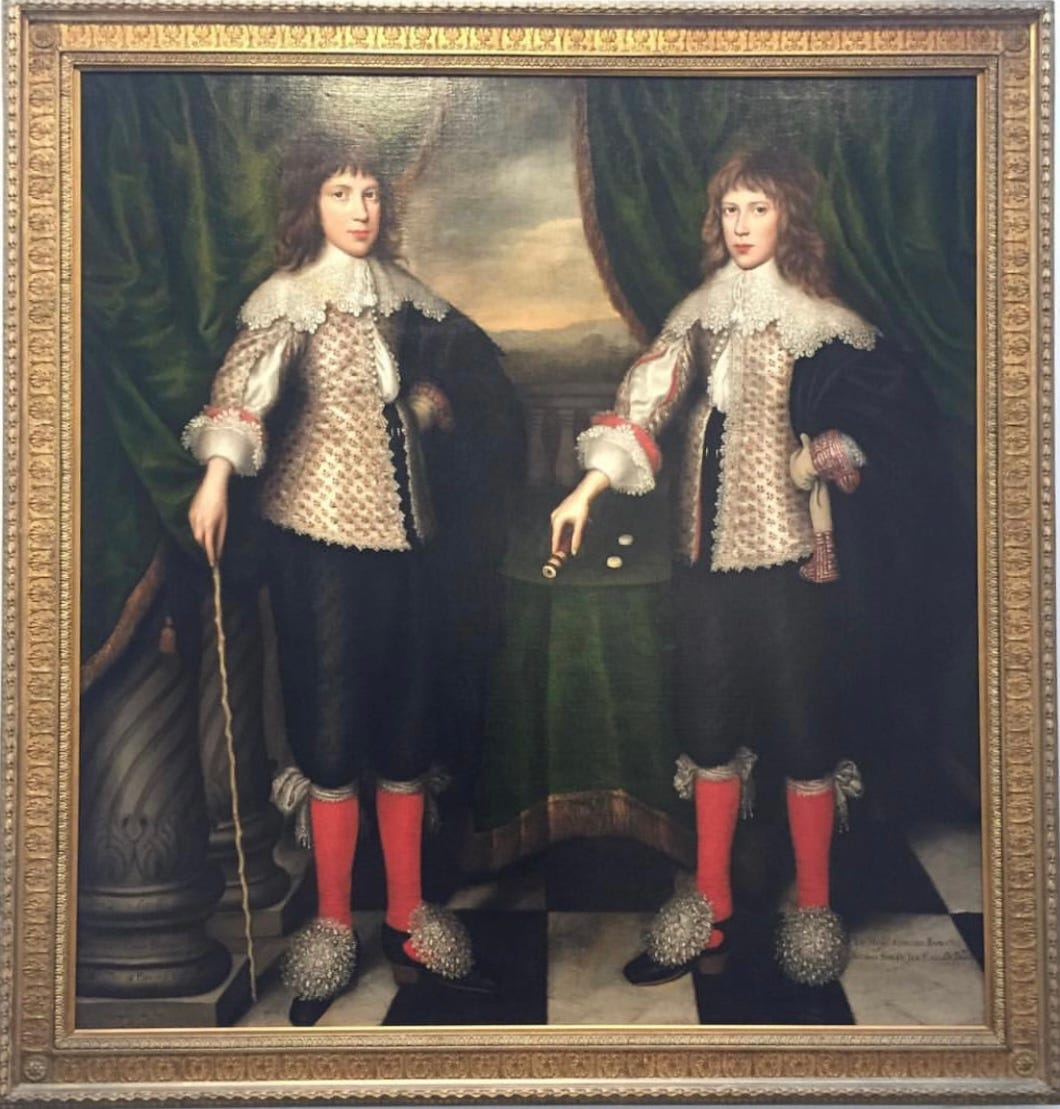
Edward is on the right. The other figure, on the left, is the Earl’s other son, Richard, Lord Buckhurst. The double portrait is part of the collection of artworks at Knole, Vita’s family’s historic home. Academic Maria DiBattista points out that it was Richard rather than Edward (pictured in Orlando) who was to succeed his father, ‘so at the outset Woolf seems to have chosen a portrait insinuating that inheritance of Knole is by no means secure for her hero/heroine.’6
Question: What role do the images play in Orlando? What effect do they have on the experience of the reader? What do you make of this image of Orlando as a boy?
The preface
Before the novel begins, we are treated to a rather funny over-the-top Preface from Woolf in which she thanks an enormous cast of people who have assisted her in the writing of the book, a list that includes Daniel Defoe, Laurence Sterne, Sir Walter Scott, Thomas De Quincy and Emily Brontë. ‘Others are alive…’ Woolf continues humorously.
Missing from the illustrious group namechecked in the Preface is Vita – though she is of course the dedicatee. Some believe that this amounts to a glaring omission from the Preface, given the extensive use Woolf makes of Vita’s life and family history. But the book itself, a portrait of Vita, would appear to excuse this omission. Moreover, the Preface is clearly intended to be silly and funny. Along with the index, table of contents and list of illustrations, the Preface forms part of the usual furnishings of the form, arranged within the walls of biography to project a spirit of seriousness and scholarship. In Orlando they wink at the reader; in a mock biography, their presence can only be a mockery.
‘He—for there could be no doubt of his sex…’
The very first line directly calls attention to Orlando’s sex – an aspect of the story that will be of great significance as Orlando’s history unfolds. This firm statement of fact which opens Chapter 1 creates an anchor that pins down this half of the story and holds the line taut for developments regarding Orlando’s sex in later chapters. DiBattista notes that this interjection in the first line (confirming beyond doubt the fact of Orlando’s sex) ‘increasingly comes to appear the desperate ploy of a biographer trying to head off trouble at the start.’ For, as DiBattista points out: ‘What reader […] would protest that Orlando was not male just one word into the book?’7
The Moor’s head
The reader first encounters Orlando, a sixteen-year-old nobleman, in the act of slicing at the head of a Moor which swings from the rafters. It is the Elizabethan age. (In fact, we will soon encounter the monarch herself!)
This section (for me at least!) is a bit difficult to read. Woolf sounds almost flippantly racist as she describes Orlando slicing at the real decapitated head of a Moor which has been tied up to the rafters for his sport and entertainment.8 We are told that this head was probably struck from the shoulders of ‘a vast Pagan who had started up under the moon in the barbarian fields of Africa’ – killed by Orlando’s father or grandfather.
The tone is light and satirical and seems intended to introduce our hero as an immature, child-at-(eccentric-aristocratic)-play rather than a racist and violent fiend-in-the-making. Of course, this sort of writing may strike a different note for readers today. About this opening scene, DiBattista writes: ‘The curse of Empire, the corrupting lust for assertive action, the simultaneously ennobling and debasing cult of heroic manhood are caricatured in the fantasy combats of a young boy.’9
Skulls and severed heads will make repeated appearances in the book. In fact, the poem Orlando sits down to work on is Æthelbert: A Tragedy in Five Acts which is probably about the King of East Anglia of the same name whose life ended in a beheading.
Orlando Furioso
But it is also worth noting that the opening scene has a literary analogue. It appears to reference Orlando’s literary namesake, Orlando Furioso, the hero of Ludovico Ariosto’s epic of the same name written in 1532. Set during the Christian emperor Charlemagne’s war with the (fictional) Saracen King of Africa, Agramante, the poem follows one of Charlemagne’s knights, Orlando, who has neglected his duty to Charlemagne due to his love for the Pagan princess, Angelica. Angelica eventually falls in love with a wounded soldier fighting for Agramante and elopes with him. Orlando is driven mad by jealousy and despair. On regaining his senses, he rejoins Charlemagne’s other knights and kills King Agramante.
It is helpful to know this story, even in outline, as certain echoes will occur through the first chapter. (There is of course another literary reference point: Orlando from Shakespeare’s As You Like It. More about that in a future post!)
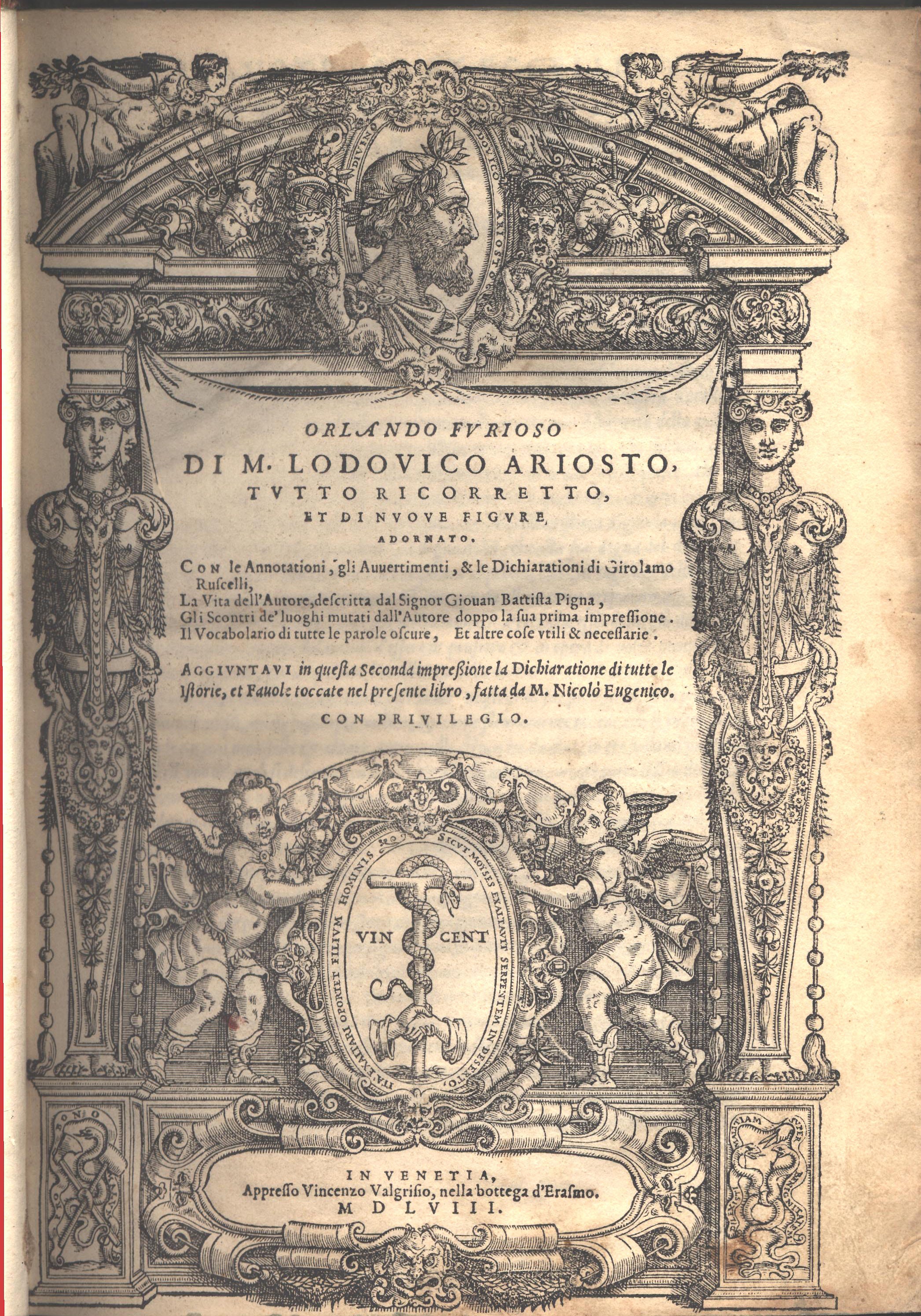
Question: What are we to make of this opening scene with Orlando slicing at the head of a Moor? What does it bring to the story? What does it tell us about Orlando and his family?
Physical description of Orlando
Readers are then treated to a ridiculously overblown description of Orlando’s physical beauty. ‘Directly we glance at eyes and forehead, thus do we rhapsodise.’ Ha ha Virginia. We also hear about Orlando’s shapely legs (a flirtatious in-joke between Virginia and Vita; Virginia thought Vita’s legs ‘exquisite’) – the first of many references to Orlando’s legs.
In this description, Woolf appears to be mocking the hagiographic tendencies of biographers, while also perhaps mimicking the bombastic modes of description of the Elizabethan Age.
Question: What effect does this description of Orlando have on the story / the reader? What conclusions might we draw about Orlando based on this description? What on earth are ‘eyes like drenched violets’? haha
The biographer
The biographer first pops up on the second page to wax lyrical about the joys of describing a life like Orlando’s: ‘Happy the mother who bears, happier still the biographer who records the life of such a one! Never need she vex herself, nor he invoke the help of novelist or poet.’ Ha ha Virginia. Very funny.
We will notice the biographer popping up here and there to make certain assertions about the art of biography or to complain or to absolve himself of anticipated criticisms. We will speak more about the biographer in future posts. However, if you’re interested in reading Woolf’s views on the art of biography, including her essay on ‘The New Biography’ published in October 1927, take a look at the posthumous collection of Woolf’s essays: Granite and Rainbow.
That’s it from me for now!
Thanks for reading to the end! I hope you enjoyed this meandery walk through some of the rich delights of this novel. See you in the comments. And then we will reconvene in a week, when we’ll discuss the first two chapters!
See Hermione Lee, Virginia Woolf, Vintage Books, 1996, 481.
Hermione Lee, Virginia Woolf, 483.
The Diary of Virginia Woolf, ed. Anne Olivier Bell, Volume 3: 1925-1930, Harcourt Brace, 1980, entry for 21 December 1925, 51.
See Julie Vandivere, ‘The Bastard’s Contention: Race, Property, and Sexuality in Virginia Woolf’s Orlando,’ in Orlando Norton Critical Edition, ed. Madelyn Detloff, W. W. Norton & Company, 2025, 234.
L F Salzman, ‘A Sixteenth-Century Portrait,’ quoted in Julie Vandivere, ‘The Bastard’s Contention: Race, Property, and Sexuality in Virginia Woolf’s Orlando,’ 233-4.
Maria DiBattista, note, Virginia Woolf, Orlando, Mariner HarperCollins, annotated edition 2006, 254.
Maria DiBattista, Introduction, Virginia Woolf, Orlando, Mariner HarperCollins, annotated edition 2006, liii.
The Cambridge Dictionary defines a ‘Moor’ as a member of the group of Muslim people from North Africa who ruled in Spain and Portugal between 711 and 1492.
Maria DiBattista, Introduction, Virginia Woolf, Orlando, Mariner HarperCollins, annotated edition 2006, lviii.


